Syllabus
Instructor: Dr. Allison Theobold – you can call me Dr. Theobold or Dr. T! I use they / them pronouns. 😊
Email: atheobol@calpoly.edu1
Office: Building 25, Office 105

Room: Building 10, Room 126
Times: Tuesdays from 12:10pm - 2:00pm
This quarter I will be holding student hours on Mondays, Wednesdays, and Thursdays at the same time—so it is easy to remember!
| Day | Time |
|---|---|
| Mondays | 12:10pm – 1:00pm (in-person) |
| Wednesdays | 12:10pm – 1:00pm (in-person) |
| Thursdays | 12:10 pm - 1:00 pm (on Zoom) |
I will typically hold student hours in my office (25-105), but may choose to move to the outside vestibule between wings of the building (where all the whiteboards are) or the Statistics department conference room. If we’re meeting somewhere other than my office, I will leave a sign on the door indicating where we’re meeting!
If you would like to talk with me one-on-one about anything (e.g., grades, research), I’ve reserved time on Thursdays from 12:10pm to 1:00pm for individual appointments. You can make 10-minute appointments through the following Calendly link
I do request that you make appointments at least 2-hours ahead of time, so I don’t accidentally miss our meeting!
If you need to meet, but none of the student hours work for you please let me know! It is possible we can communicate asynchronously through Discord or email, but I am happy to schedule a meeting during another time if necessary.
Course Texts
This course follows Data Feminism by Catherine D’Ignazio and Lauren F. Klein. You can access every chapter online (link to online text) or you can choose to purchase the physical copy of the book through MIT Press (link to purchase a physical copy of the book). The authors (and I) request that you please don’t purchase the book from Amazon!
In addition to this book, we will draw on many books and academic papers. I will make all course readings available on Perusall, which can be accessed through our course Canvas page.
Infrastructure
Canvas will be your resource for the course materials necessary for each week. Each module will walk you through what you are expected to do each week, including:
- chapters to read
- reading annotations
- group book presentations
- group final projects
Make sure you are receiving email notifications for, at least, announcements and emails. In Canvas, click on your name, then Notifications. Check that Canvas is using an email address that you regularly check; you have the option of registering a mobile number. Check the boxes to get notifications for announcements, and optionally other Canvas activity.
All course readings and recorded lectures will be available on Perusall. You can access Perusall via our course Canvas page.
This quarter, we will make use of a class-wide Discord Server. The link on Canvas will help you join this server. Refer to the Using Discord guide on Canvas for more information on how to effectively use this server.
Joining the Discord is not optional. Discord is the primary avenue for earning community labor points by initiating conversations, responding to conversations, or answering course questions.
Discord is also the best way to possibly get your questions answered outside of ordinary class and office hours.
Course Description
Explores relationships among data, power, and justice through feminist theory. Students examine how oppression shapes data practices and learn feminist strategies for recognizing bias, critiquing inequities, and designing ethical, justice-oriented approaches to data collection and analysis.
Course Objectives
After taking this course, you will be able to:
Describe feminism as a critical theoretical framework for understanding systems of power and oppression.
Discuss how feminist theoretical principles can be used to understand the power dynamics underlying data practices.
Operationalize a feminist lens to:
- Identify how data collection practices and analyses can uphold systemic biases.
- Explain why data collection practices and analysis could harm groups of individuals.
- Illustrate how various historical events influence how data are collected / represented today.
Develop a protocol for assessing the historical, material, and ethical contexts of a dataset.
Apply said protocol to critique a data collection or analysis plan from a justice-oriented lens.
Learning Objective (LO) #1 and #2 will be assessed by weekly reading annotations and performance in classroom discussions.
LO #3 will be assessed by book presentations in Week 7.
LO #4 and #5 will be evaluated by the development of a data context protocol and the application of the protocol to critique the data collection or analysis of one of the provided datasets.
Assessment
In this class we will be using a contract grading system. This is designed to give flexibility and freedom to explore while ensuring a level of accountability.
There will be four different types of assignments in this course—reading annotations, group book presentations, group data context protocol, and community labor. You can read more about each specific assignment type here.
Topics
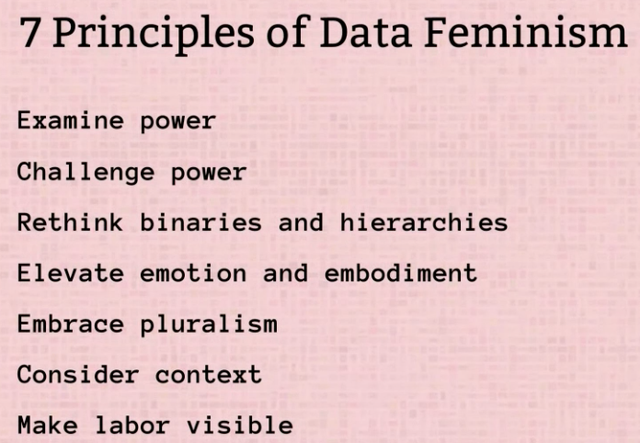
The course will roughly follow the sequence of topics in Data Feminism, focusing on the following principles:
Classroom Community and Policies
This is a 2-credit course with 2 hours per week of in-classroom instructions. Cal Poly expects students to devote 4 out-of-class hours per week to 2-credit classes. I have designed the course assignments and selected the course readings with this target in mind.
Attending class is not only important for your learning but also an act of community. Many course assignments will be completed in-class, and many critical thinking skills will be honed in class.
Attendance will be taken in the first 10-minutes of each class. You may miss one class with no penalty. You do not need to inform me that you will be absent, but you should let your group members know. After the second unexcused absence, your grade may drop by one third of a unit (as specified by the grade contract). Students arriving more than 10-minutes late for class without having informed me ahead of time will be marked as absent.
If you must miss a class entirely, you should review the class notes posted to the #class-notes channel on Discord.
I understand that you will sometimes need to prioritize other things over meeting assignment deadlines (e.g. your health, wellness, families, communities, jobs, other coursework). However, there are a number of reasons that I find enforcing deadlines to be supportive of student learning in this course:
First, one of the key aims of assignments in this course is to support you in learning to become more perceptive to data environments surrounding you. Because of this I’ve deliberately spread course assignments out over the semester in order to help you gain practice in consistently paying attention to these environments. This critical mode of thinking can’t be cultivated effectively if the work is being crammed into later parts of the semester.
Second, because this course emphasizes student growth over achievement, I also want to ensure that I can provide feedback on your writing in time for you to incorporate it into future assignments.
There is a 24-hour grace period on all written assignments. There will be no penalties for submitting the written assignment within this 24-hour period, and you do not need to inform me that you intend to take the extra time. You can also request up to a 72-hour extension on any written assignment, as long as you make that request at least 24-hours before the original assignment due date. You can request an extension by filling out the Extension Request form on Canvas, and I will confirm your extension on Slack.
All deadline extensions must be done through the form, so I can keep track of who has used their allotment of extensions. If you are registered with DRC to have deadline extensions, you are required to complete a deadline extension request and make a note if your extension is related to a need related to DRC accommodations.
Any late work is required to have a deadline extension request, meaning if you do not complete a deadline extension request for an assignment you are not permitted to turn it in late. The link to the deadline extension form can be found in Canvas in the Course Information module (at the top of the page).
Reading assignments/Perusall annotations need to be completed by the due date for credit.
Cal Poly expects all students to be honest and committed to the principles of academic and intellectual integrity in their preparation and submission of course work and examinations. Students and faculty at Cal Poly are part of an academic community defined by its commitment to scholarship, which depends on scrupulous and attentive acknowledgement of all sources of information, and honest and respectful use of college resources. Any cases of dishonesty or plagiarism will be reported to the office of Students Rights and Responsibility. Examples of dishonesty or plagiarism include:
- Submitting work completed by another student as your own.
- Copying and pasting words from sources without quoting and citing the author.
- Paraphrasing material from another source without citing the author.
- Failing to cite your sources correctly.
- Paying another student or service to complete assignments for you.
For reasons we will discuss in the course, this course takes a strict no AI policy. The use of generative AI tools (such as ChatGPT, Google Gemini, Microsoft Copilot, Claude, etc.) is strictly prohibited. All assignments, essays, and other submitted work must be your original, independent creation. Submitting AI-generated work will be considered a violation of the Cal Poly Academic Integrity Policy. Such violations will be treated as plagiarism and may result in a failing grade for the assignment or the course.
Active participation in this course is generally expected and encouraged. That said, we all have off-days—be it from illness, sadness, heartbreak, or exhaustion. I too will have off-days where my words just don’t seem to cohere, or my brain will feel jumbled. Because of this, I’ve provided a number of ways to demonstrate engagement throughout the semester.
I have put a lot of thought into the assigned readings for this course—aiming to select pieces that are relevant, engaging, challenging, accessible, and represent a diverse set of voices. Our classroom discussions will be much richer, more meaningful, and fun when all students come to class having completed and annotated assigned course readings. While I know that reading may seem like a low priority when you have impending assignments that you need to physically hand-in, I encourage you not to wait until the last minute to complete course readings. You will get the most out of the content if you give yourself time to digest and reflect on it.
If you are struggling to keep up with the readings, please reach out to me. I’m more than happy to talk through effective reading strategies and to provide more guidance on what I’d like you to get out of a specific piece.
Community
As the instructor for this course, I am committed to making participation in this course a harassment-free experience for everyone, regardless of level of experience, gender, gender identity and expression, sexual orientation, disability, personal appearance, body size, race, ethnicity, age, or religion. Examples of unacceptable behavior by participants in this course include the use of sexual language or imagery, derogatory comments or personal attacks, trolling, public or private harassment, insults, or other unprofessional conduct.
As the instructor I have the right and responsibility to point out and stop behavior that is not aligned to this Code of Conduct. Participants who do not follow the Code of Conduct may be reprimanded for such behavior. Instances of abusive, harassing, or otherwise unacceptable behavior may be reported by contacting the instructor.
All students and the instructor are expected to adhere to this Code of Conduct in all settings for this course: seminars, office hours, and over Slack.
This Code of Conduct is adapted from the Contributor Covenant, version 1.0.0, available here.
Following Ihab Hassan, I strive to teach statistics so that people will stop killing each other. In my classroom, diversity and individual differences are a sources of strength. One of the greatest failures of Statistics, historically and in the present, has been the exclusion of voices from the field. Everyone here can learn from each other, and doing so is vital to the structure of the course. Significant portions of this course involve group work and discussion in class. Some discussions will touch on sensitive topics. So that everyone feels comfortable participating in these activities, we must listen to each other and treat each other with respect. Any attitude or belief that espouses the superiority of one group of people over another is not welcome in my classroom. Such beliefs are directly destructive to the sense of community that we strive to create, and will sabotage our ability to learn from each other (and thus sabotage the entire structure of the course).
In this classroom, I expect you to be polite, respectful, inclusive, and open-minded.
Some examples of how to be a good classmate include:
- Check-in with colleagues before starting collaborative work. “What three words describe how you’re feeling?” “Name one challenge and one success from this week.” “What are you doing for self-care right now?” Thank each other for sharing where they’re at.
- Consider when to step up and when to step back in class discussions, creating space for others to contribute. Listening is just as important to community-building as speaking.
- Acknowledge that there is much we don’t know about how our colleagues experience the world, but don’t ask colleagues to speak on behalf of a social group you perceive them to be a part of.
- Cheer on colleagues as they give presentations or try something out for the first time.
- Ask questions often in our weekly
#questionschannel. Help each other out by answering questions when you can. - Mistakes happen. I will certainly make mistakes in class. Admit mistakes, and then move on.
Using the proper pronouns for everyone is foundational to a safe, respectful classroom environment that creates a culture of trust. For information on pronouns and usage, please see the Division of Student Affairs link here: Pronouns
Support
This quarter, I am instating a policy that I do not respond to emails with questions of general interest, such as deadline clarifications or conceptual questions. If you have one of these questions, please post your question on our course Discord server.
If you send my a DM on Discord asking a question that I believe other students would benefit from seeing my response, I will likely choose to answer it in one of the public channels of Discord instead. Please don’t take this personally! It just means that you asked a good question, and I think the rest of the class could benefit from seeing the answer.
I enthusiastically support the mission of Disability Resource Center to make education accessible to all. I design all my courses with accessibility at the forefront of my thinking, but if you have any suggestions for ways I can make things more accessible, please let me know. Come talk to me if you need accommodation for your disabilities. I honor self-diagnosis: let’s talk to each other about how we can make the course as accessible as possible. See also the standard syllabus statements, which include more information about formal processes.
If you have difficulty affording groceries or accessing sufficient food to eat every day, or if you lack a safe and stable place to live, and you believe this may affect your performance in the course, I urge you to contact the Dean of Students for support. Furthermore, please notify me if you are comfortable in doing so. This will enable me to advocate for you and to connect you with other campus resources.
National surveys of college students have consistently found that stress, sleep problems, anxiety, depression, interpersonal concerns, death of a significant other and alcohol use are among the top ten health impediments to academic performance. If you are experiencing any mental health issues, I and Cal Poly are here to help you. Cal Poly’s Counseling Services (805-756-2511) is a free and confidential resource for assistance, support and advocacy.
A trigger is a topic or image that can precipitate an intense emotional response. When common triggering topics are to be covered in this course, I will do my best to provide a trigger warning in advance of the discussion. However, I can’t always anticipate triggers. With this in mind I’ve set up an anonymous form, available on Canvas, where you can indicate topics for which you would like me to provide a warning.
I will listen and believe you if someone is threatening you. I will help you get the help you need. I commit to changing campus culture that responds poorly to dating violence and stalking.
If you are responsible for childcare on short notice, you are welcome to bring children to class with you. If you are a lactating parent, you many take breaks to feed your infant or express milk as needed. If I can support yo in navigating parenting, coursework, and other obligations in any way, please let me know.
Footnotes
See Section 5.1 (Getting Help) for information on what you can expect when you email me.↩︎